The Mosi Oa Tunya Perennial Reimagines the African Art Biennale
Far from the major art capitals and their established institutions, a gathering in Livingstone, Zambia, is making a case for new ways of thinking about contemporary African art and community.
Tšeliso MonahengTšelisoMonahengJohannesburg-Based Southern Africa Correspondent
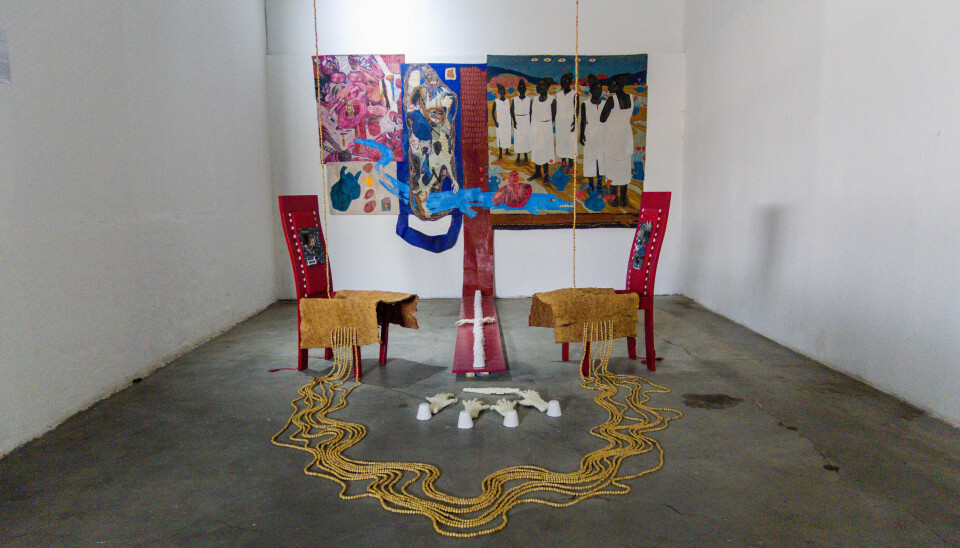
An installation at the Musi Oa Tunya Perennial.Sello Majara for LoCA/Musi Oa Tunya Perennial.
There are currently four biennales taking place across the African continent: the Lagos Biennial in Nigeria, Senegal's Dak'Art, Bamako Encounters in Mali, and Morocco's Casablanca International Biennale, each playing host to art forms ranging from photography to contemporary African art. These, along with the 19th edition of FNB Art Joburg in Johannesburg, South Africa, paint a picture of an African art scene preoccupied with what happens in major metropolises, to the detriment of other, less established locales. This is the status quo the Mosi oa Tunya Perennial sets out to challenge, throwing a wrench into the machinery of a gaze that sometimes weaponizes popularity against craft.
This week, as part of a six-month program that kicked off in September, artists of all disciplines — sound, fine art, music — descended on Livingstone, Zambia, for the perennial, organized by the Livingstone Office for Contemporary Art (LoCA). Conversations with curator Lineo Segoete and writer and contemporary artist Bwanga Kapumpa made it clear that the ideas underpinning the event had been percolating for a long time. Before this, according to Kapumpa, LoCA had hosted "at least one exhibition, and these small artist residencies we call mini-labs."
"Emerging artists would be invited to learn about contemporary art and how to think critically about their work, how to tell stories that are valuable to people — to give art more than just aesthetic value," he says. Then, last year, came a concerted effort to produce a bigger exhibition.
Lineo Segoete addresses the audience on launch day.Sello Majara for LoCa/Mosi Oa Tunya Perennial.
For Segoete, getting involved was also political. She wanted to use art to speak out against imposed borders and against the encroachment of hate — doubtless a product of our constant state of coloniality — and to experiment with organizing a big gathering outside traditional funding models. "We need funding," she says, "but if a funding call has things that don't necessarily agree with our principles, then we'd find another way, you know?" By "another way," she means private funders and, at times, fronting the money from her own savings. "It's not to glorify struggle or minimize that there's a privilege attached to the fact that we're able to use alternative means to still get shit done. It's to say, we make means with what we have in our hands already."
"The idea of the perennial comes from the fact that regardless of what happens in the environment, the same activities happen in a cyclical manner," she says, using the analogy of elephants to drive her point home. "Whether there's a drought or a flood, the elephants will come and go through paths that they're used to. They'll eat the same plants that they're used to, and there's an ecosystem to that. For us, it relates because here we are advocating for a historicizing of our art histories, for a robust engagement in critical art theory and practice, and also advocating for subsistence. We need support with this."
The installations and pieces at the Mosi-oa-Tunya Perennial in Livingstone, Zambia.by Sello Majara for LoCA/Musi Oa Tunya Perennial.
The installations and pieces at the Mosi-oa-Tunya Perennial in Livingstone, Zambia.by Sello Majara for LoCA/Musi Oa Tunya Perennial.
The installations and pieces at the Mosi-oa-Tunya Perennial in Livingstone, Zambia.by Sello Majara for LoCA/Musi Oa Tunya Perennial.
The installations and pieces at the Mosi-oa-Tunya Perennial in Livingstone, Zambia.by Sello Majara for LoCA/Musi Oa Tunya Perennial.
The installations and pieces at the Mosi-oa-Tunya Perennial in Livingstone, Zambia.by Sello Majara for LoCA/Musi Oa Tunya Perennial.
The installations and pieces at the Mosi-oa-Tunya Perennial in Livingstone, Zambia.by Sello Majara for LoCA/Musi Oa Tunya Perennial.
The installations and pieces at the Mosi-oa-Tunya Perennial in Livingstone, Zambia.by Sello Majara for LoCA/Musi Oa Tunya Perennial.
The installations and pieces at the Mosi-oa-Tunya Perennial in Livingstone, Zambia.by Sello Majara for LoCA/Musi Oa Tunya Perennial.
The installations and pieces at the Mosi-oa-Tunya Perennial in Livingstone, Zambia.by Sello Majara for LoCA/Musi Oa Tunya Perennial.
The installations and pieces at the Mosi-oa-Tunya Perennial in Livingstone, Zambia.by Sello Majara for LoCA/Musi Oa Tunya Perennial.
The installations and pieces at the Mosi-oa-Tunya Perennial in Livingstone, Zambia.by Sello Majara for LoCA/Musi Oa Tunya Perennial.
The program is framed around the idea of smuggling as an act of resistance. A glance at the lineup finds Ghana's FOKN Bois in a constellation that also includes Zimbabwe's Bantu Spaceship and Lesotho's Morena Leraba and 'Matlali Matabane. These sonic dialogues act as interlocutors, expanding a conversation carried on elsewhere in the program: Johannesburg's Keleketla! Library presents 69 Years from the Treason Trial: The Drill Hall Arts Advocacy Project; Segoete and LoCA founder Anawana Haloba discuss pedagogies through sound in chorus with Gabi Ngcobo and Hera Chan; and MADEYOULOOK, Chimurenga, and Nashilongweshipwe Mushaandja set perennial portals in orbit. There are subthemes, too: one around land and its ability to act as both repository and conduit for memory, another around language and its ability to carry meaning across imposed borders.
"[In this instance], smuggling means overcoming institutional borders. It's based on themes of how, previously, colonial powers, or even other institutions today, will maybe have restrictions or barriers around certain types of knowledge. We weren't permitted to move the way we initially wanted to move because of how the continent was cut up," says Kapumpa. "Even within the country itself, you have different borders, different provinces, but people still find ways to get things done. It's not smuggling to glorify illegal activity; it's in the sense of finding ways to resist some of the restrictions that might be imposed on certain things we are trying to do."
Adds Segoete: "We're drawing very much from the liberation struggle, how smuggling was a strategy that, over and above other means of keeping the movement alive, was one of the most useful and successful — by way of ideas, people, even weapons and goods."
People viewing art at the opening of the Mosi Oa Tunya Perennial.Sello Majara for LoCA/Mosi Oa Tunya Perennial.
The perennial draws inspiration from biennales elsewhere but isn't necessarily copying their model. The question is how to do it with what's already here, in a place without, say, large art institutions, galleries, or schools for artistic practice. There's also an overtly pan-African stance, and it's intentional. "With the kind of political climate we find ourselves in, there's a need to remind ourselves that we're related. So it's also to emphasize kinship; as much as you can point at the other and say, 'You're a foreigner,' there's more that ties us together than you realize," says Segoete. "From where we stand, it's like, how do we embody [pan-Africanism] through the kind of discourse we promote, the kind of programming we create, and the kind of people we surround ourselves with?"