The Rich Sudanese Tapestry of the Elgizouli Sisters
Hiba, Mai, and Sally have made names for themselves by telling sonic and visual stories that sound and look out of the ordinary while playing with the vastness of Sudanese culture.
Amuna WagnerAmunaWagnerCairo-Based North Africa Correspondent
The collaborations with her sisters have helped to elevate Hiba’s music and afforded her many opportunities. “You know how music works; you need visuals,” she says. “It also opened up different dimensions that I didn’t necessarily have in mind.”courtesy of The Elgizouli Sisters
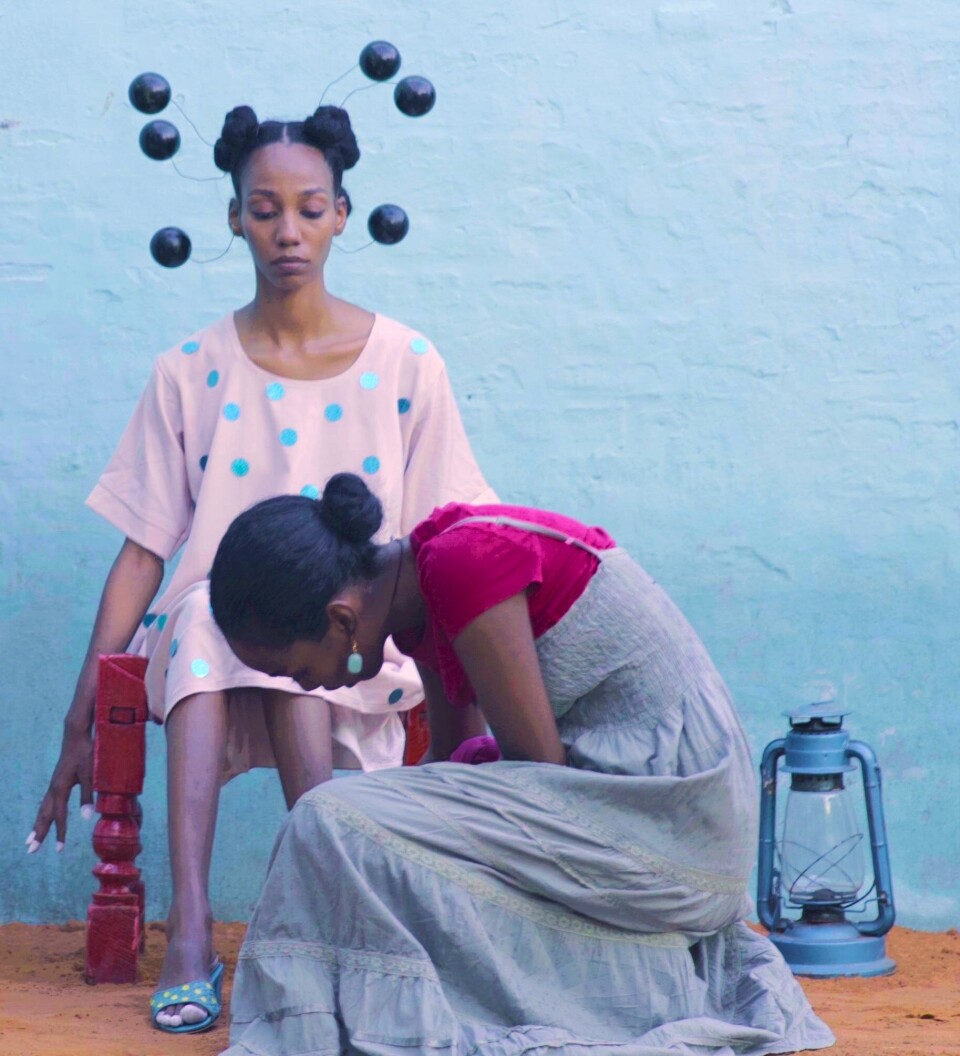
In 2018, one year before the revolution, a music video made the rounds in Khartoum. A young woman stands in front of a light-blue Sudanese house, wearing various colorful toubs, and singing confidently yet nonchalantly into the camera. In one shot, she wears earrings made from bougainvillea flowers that grow outside the house; in another, she dances in a pink dress, with pink plastic balls attached to long braids bobbing around her waist. This imagery, so surreal, perfectly color-coded and steeped in Sudanese tradition, looked like nothing we had seen before. I remember thinking that this is the kind of art Solange would make if she were Sudanese.
The music video was for Hiba Elgizouli’s song “Rival.” It had been filmed, directed, and produced by her older sister, Mai. The design was by their older sister Sally. They had zero budget for their project, only Mai’s inspiration from Hiba’s music, Sally’s talent for visual storytelling, and the sisters’ love for playing together.
Advertisement
“It was a difficult time in Sudan; everyone was complaining about bread and queues for fuel,” says Sally. “But we were always inspired,” adds Hiba. Mai got a camera from “a guy at the Goethe-Institute,” and while doing the first test shots, she realized that her vision was grander. “I needed props and costumes to fill my eyes,” she says. “I was wrapping Hiba with something green when Sally came home, really tired from work. I told her ‘we need you in the music video’ because I knew she could do it better.’”
Raised by an artistic father, the Elgizouli sisters have merged their creative worlds all their lives. Mai created the set for one of Hiba’s first YouTube videos, perfectly aligning all her nail polish in the background and opening Hiba’s wardrobe, which was filled with perfectly folded, color-coded clothes.
Sally came across Yayoi Kusama’s work during a difficult time in her life, and since then she has had a special love for polka dots, balls, and geometric shapes. When Mai asked her to help with Hiba’s music video, she had a chance to put this inspiration into practice.courtesy of The Elgizouli Sisters
“As a family, we went through really challenging times because of economic hardship and when we sought asylum in Egypt,” says Sally. “There was a lot of turbulence, and we were creative during that time. Maybe it was our way to deal with these challenges.”
The sisters inspire each other to grow. Musically, Hiba felt she needed to step up the visual work her sisters were doing for her songs. “I felt like I needed to make something sophisticated, but at the same time I was thinking simple, so that I can do it on my own with just a piano, bass, and backing vocals,” she says. “I always thought ‘oh my God, the music doesn’t even match the level of the visuals.”
“Rival” found widespread resonance, so the sisters embarked on a bigger project for Hiba’s song “Bidaya.” They started a crowdfunding campaign and continued to lean on the community support that had enabled them to shoot “Rival.”
Written in 2018, “Bidaya” (Arabic for “Beginning”) wrestles with the feelings of helplessness and hope that many Sudanese youth felt at the time. The visuals pick up on some of the themes that the sisters first explored in “Rival,” notably the use of polka dots and balls, Sally’s signature style. She bought different kinds of balls, wires, and scarves from the market, and an electrician who became her good friend. The outfits and the surrealist imagery were all created by the sisters themselves.
“Everything was in my sketchbooks, and sometimes I was surprised that it actually looked really artistic,” says Sally with a laugh. “I had inspiration from my father, an environmentalist. In the last ten years of his art practice, he used to recycle and make masks from trash.”
“We used to play mermaids,” Sally remembers. “It was very serious, wrapping blankets around us.” This love for mermaids shows in their later creative work, especially in the music video for “Bidaya.”courtesy of The Elgizouli Sisters
Wearing mermaid-esque and disco-esque costumes, Hiba embodies a bride of the Nile. In typical youngest-sibling fashion, she wore whatever Sally told her to and moved the way Mai instructed her to. “I never have to criticize Sally,” says Hiba. “When she draws dots on my body, I feel like this is exactly how I want to feel and look right now.” However, taking feedback on her music is another story. “If they tell me to go sit inside a hole, I’ll be like ‘YES,’ but if they judge my music, I’m so sensitive,” she laughs.
“Bidaya” was the sisters’ most challenging collaboration because of the large number of other people they needed to involve to bring their vision to life, and the pressure that came with the crowdfunded money.
“We used to play as sisters and also fight as sisters,” says Sally, before the three go on to tell of the many issues they had coordinating on set. “I felt really exhausted and stressed, especially doing all of this in Sudan is hard,” remembers Mai. “I was really tough with Sally and Hiba.” “What do you mean? I was always on time,” jokes Hiba and laughs as Mai threatens, “We’ll fight again.”
“We used to create under the protection of our parents. Our household was very warm, and our parents were proud of our projects.” - Sally Elgizoulicourtesy of The Elgizouli Sisters
Defying challenges like a lack of electricity or the outbreak of an uprising, “Bidaya” was finally edited in Cairo after their mother had evacuated them in the wake of the June 3rd Massacre. In Egypt, Mai specifically struggled to find an editor who would honor her vision. “Being female, leading something and having a loud voice, you have to prove yourself for people to get you,” she says.
The sisters have not put out a collaboration since “Bidaya,” but they have been working behind the scenes. Their respective art practices have evolved over the years–Hiba is exploring different musical styles, Mai is pursuing an MFA in Photography, Video, and Related Media in New York City, and Sally’s fascination with circles has expanded into an explanation of geometric shapes in general—but at the core of their work, they continue to tell stories about women.
Their most recent creative encounter was for “Moya wa Nar,” music that Hiba wrote in 2019 but is only releasing this July. “Hiba’s music moves me even if I’m depressed,” says Mai, who has already written a Moya wa Nar film that she is hoping to realize. “And with Sally’s work, I know any project can go to another level.”
For “Moya wa Nar,” Sally created Umjobi, a character who is half-clown and half-witch, inspired by the song’s reference to zar in its lyrics. A zar, also called a Red Wind, is a spirit that possesses people and must be appeased through an elaborate ritual involving music, incense, clothing, and jewelry.
“Mai once said that there’s an Umjobi inside her, and I told her that there’s an Umjobi inside of everyone, especially in women who grew up in Sudan during a very difficult time,” says Sally. “Umjobi is a character who is trying to be herself, and because she’s under a lot of pressure, she turns into a creature that is so odd.”
Umjobi’s fictional origin story is that she is part of the pantheon of zar characters, a new-ish addition that represents the majority of modern Sudanese women. Umjobi — Umm Jobi — is Arabic for the mother of Jubi, a boy Hiba invented as a child.
“Hiba used to have many characters that she would imitate, and every one had their own voice,” remembers Sally. “Mai went with her into this world sometimes. My father told her ‘it makes sense that you sing, because you have this vocal energy in all your characters.’”
“I think about a story more than a concept or an outfit.” - Sally Elgizouliby Sally Elgizouli
As the sisters continue to grow in their art, they are each other’s reference and sounding board. Drawing on Sudan’s rich heritage, they nonetheless do not feel the need to represent or educate. Rather, they reflect their own experience, knowing that it is shared by many other young Sudanese women.
“I want our audience to have fun and experience the joy of being imaginative,” says Sally. “It’s beautiful to see that people who are not from the diaspora and have money have the confidence to do their thing, for example, in the rap scene. But I’m missing women. I hope that women can express themselves more creatively.
“I miss being amazed. I want people to see something they’ve never seen before,” says Mai. “‘Rival’ was the first time you saw Sudanese women on screen with their natural hair. I like to shock people.”
Hiba wants their work to encourage others to collaborate with their families. “We didn’t have any material resources, but we had each other,” she says. “I wish for people to see that. The world is tough, and money helps, but what really helped us is being together as a family.”