When South Africa’s luxury fashion house MaXhosa’s Siyikulture collection spilled custard on a Paris runway, it reminded us why skhothane still matters, and why it draws so much outrage.
Tšeliso MonahengTšelisoMonahengJohannesburg-Based Southern Africa Correspondent
A moment by South African luxury fashion house MaXhosa Africa on a fashion runway in Paris brought the Skhothane subculture back into sharp focus — a phenomenon in which young people bought (and sometimes burnt or destroyed) fancy brand clothes and shoes and spilled custard everywhere.by Per-Anders Pettersson/via Getty Images
This past weekend, fashion label MaXhosa Africa unveiled its Autumn/Winter 2026 collection in Paris, France. Titled Siyikulture (We are culture), it marked the brand’s fifth consecutive appearance on the official calendar, with attendees including musician Bongeziwe Mabandla, who has been associated with the brand since early in his career. Dancer, musician, and media personality Robot Boii curated a segment that fused disparate elements of South African street culture, from gumboot dance to amapiano, with touches of skhothane culture thrown in.
Crucially, there was a moment when custard was spilled on the runway, sending South Africans on X (fka Twitter) into a frenzy. But to understand that moment, we need to dial it back to 2012.
A controversial television exposé that aired on 3rd Degree, broadcast by eNCA (formerly e.tv), brought izikhothane (from the isiZulu word ukukhotha, meaning to ‘to lick,’ adopted in everyday language to mean ‘show off’) to a wider public. In the introductory segment, journalist Debra Patta describes it as “a disturbing new phenomenon,” adding that parents were distressed and up in arms about kids spending fortunes on “flashy designer gear.” She goes on to claim that they trashed the clothes and “brazenly” burned money in an attempt to gain social status. “It is bling gone obscenely mad,” she concludes — condemning language for a group of kids from the hood (Katlehong, in this instance) who were, in many ways, trying to figure out their path through life.
That framing alone sets the precedent for what follows. Before the programme even unfolds, the viewer is already primed to see these ‘youths’ as wasteful, uncaring, and inconsiderate — overall, as horrible little scoundrels who should know better than to waste their parents’ hard-earned money. As so often happens with media-mediated narratives, this one took hold. It is still being parroted on social media by people whose knowledge of the scene is, at best, limited and, at worst, far removed from how the culture has evolved beyond its big television moment.
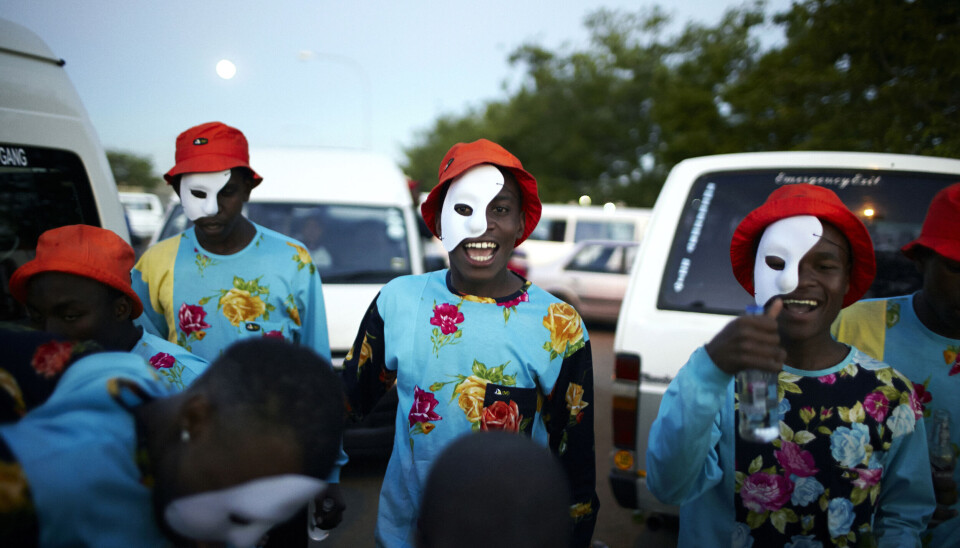
What many routinely fail to note is that skhothane culture has seeped into the South African cultural lexicon. Everyone from rappers to amapiano producers to fashion designers has found ways to incorporate its aesthetic, characterised by flamboyant, colour-saturated clothing — think patterned knits from DMD Muracchini and Italian designer shoes like Rossimoda Pagani loafers or Floreal GTs. Maglera Doe Boy frequently drops the references in his raps: “Upper echelon skhothane / Makazana re bone Bovana,” on Dee Koala’s “Gwan,” and on Boity’s “018s Finest”: “I ain’t skhothane, bamba ngwanyana ka di Ultramel.” Ultramel is a popular South African custard brand. In the video for one of 2023’s signature amapiano songs, “Bhebha,” everyone is decked out in the colorful regalia associated with izikhothane.
Soweto Rising is a documentary film by Noxolo Mafu and Lilian Magari. In a segment featuring King Mosha, a dancer and self-proclaimed Isikhothane (the singular of Izikhothane), a layer of complexity is added to the custard-coated mainstream view that adherents of the craze are wasteful, ungrateful, and pointless.
“Previously, we used to wear Carvelas. But now, it's obvious I have to wear the Italian shoes...Italian wear,” says King Mosha, pointing to how izikhothane have changed with the times. "It's like technology. Everything upgrades, and then it's upgraded."
As shorthand, izikhothane represents the younger, wilder iteration: the unemployed yet aspirational youth who later graduate to a higher level, the Italians, where tailored suits and understated luxury replace the earlier flamboyance.
Everyone from rappers to amapiano producers to fashion designers has found ways to incorporate the skhothane aesthetic into their daily lives.by Per-Anders Pettersson/via Getty Images
The Politics of Waste: Refusing the Economy of Respectability
The upgrade narrative does warrant scrutiny. While the graduation from custard-soaked flamboyance to tailored Italian suits is legible as growth, it is also a movement toward a register of Blackness that polite society finds easier to accommodate. The question: Does this accommodation represent arrival, or a more sophisticated form of the same disciplining impulse?
The moral panic that erupted around izikhothane was never truly about waste or irresponsibility. It was about the particular discomfort that arises when Black youth from the township assert a radical, embodied refusal of scarcity, a refusal that polite society neither anticipated nor could easily metabolise. Patta's language —"disturbing," "obscenely mad," "brazenly"— is the language of containment, the rhetorical machinery deployed whenever Blackness exceeds its assigned boundaries. These were children from Katlehong, a place structurally designed, through interventions enacted by the Apartheid-era dispensation, to produce lack, performing abundance on their own terms. That the performance involved destruction — burning notes, soiling expensive clothing — was not incidental, but the whole point. To destroy what you were never supposed to own is a profound act of negation, a refusal to participate in the economy of respectability that insists Black life must justify its excesses to White and middle-class audiences who never once had to justify their own.
What the dominant narrative consistently cannot hold is the idea that izikhothane were not confused about the value of money. They understood it perfectly, which is precisely why they burned it. In a society where Blackness is perpetually locked in a relationship of structural indebtedness — where Black people are forever catching up, saving up, making do, always feeling incomplete, not enough — the spectacular squandering of capital reads as heresy. But Afro-pessimism asks us to sit with exactly that discomfort: to consider that for a subject position defined by its exclusion from the social contract, conventional frameworks of waste and value do not apply in the same way. The condemnation of skhothane culture is a tale about anti-Blackness; about the deep structural impulse to discipline Black joy, Black excess, and Black self-determination whenever it dares to appear without apology.
The custard will keep spilling. In township yards and city streets, in amapiano videos, on runways in Paris. Each iteration carries less of the original dirt and more of the gloss, an inevitable progression when attention is brought to a subculture. But the kids in Katlehong in 2012, burning their money and soiling their clothes, were not waiting for a fashion week moment to validate what they already knew: that they existed, that they were spectacular, and that they owed no one an explanation for either.