Cairo Brims With Sound, But Has Too Little Space for Music
Between a dire financial crisis and the government’s continuous crackdown on independent art, the Egyptian capital is losing spaces for collective music experiences that can reach people of all backgrounds.
People watch a live singer perform as "Art Street" has been transformed into an open art space hosting visual artists, painting exhibitions, and musical performances in Cairo.by Mohamed Elshahed/Anadolu via Getty Images
Last February, I hopped on a small boat on the Nile and crossed from its Giza shore to Qursaya Island for the annual Nile Parade. Qursaya, home to local farmers and fishermen, hosted people from all over Cairo for a day of workshops, an exhibition, delicious food, and live music. We learned about the challenges that communities face along the Nile from Ethiopia to Egypt, cheered as fishermen showed off their boats-turned-art-installations, and danced to Nubian and Sudanese music.
In the seven years that I have lived in Cairo, the Nile Parade has become one of my favorite memories. I remember it fondly because these kinds of community events are exceedingly rare; Cairenes rarely get to gather in a public space, sit in the grass, and listen to music with people from different social classes and backgrounds.
The Nile Parade takes over Qursaya Island, drawing a lively crowd for a day packed with music and art, all rooted in the Nile and the bonds its people share with it.by Doaa Adel/NurPhoto via Getty Images
The quiet disintegration of public space
This wasn’t always the case. Any resident of Cairo will tell you about the city’s immersive soundscape, its rhythms and horns and calls to prayer. Egypt’s capital has a never-ending hum that is both challenging and inspiring. Music spills onto the street from open car windows, ahwas (street cafés) and people on the road going about their day, singing at the top of their lungs. It’s counterintuitive that such a vibrant city lacks accessible third spaces for collective music experiences.
“What does it mean to have a city that is disappearing on purpose?” scholar and urban anthropologist Omnia Khalil asked in an interview with OkayAfrica in 2025. “The Cairo that we know has disappeared already.”
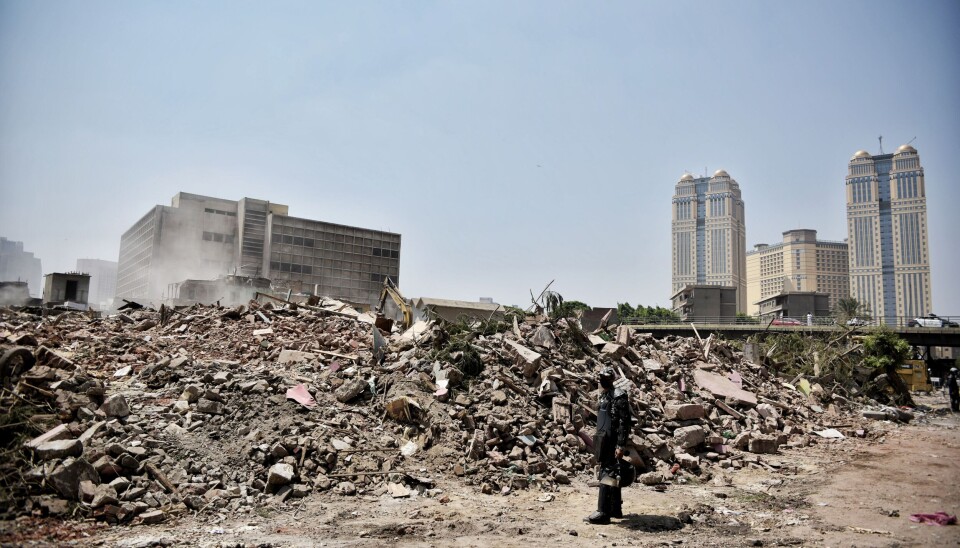
Khalil referred to the military regime of Abdel Fattah El-Sisi and its deliberate restructuring of Cairo. Since taking power in a 2013 coup, his government has engaged in what Robert Flahivecalls “regime-security urbanism: the reorganization of space to limit the potential for mass mobilization.”
A soldier of the Egyptian Central Security Forces stands guard amid the debris of demolished buildings in a slum that is part of the Rod El Farag neighborhood, with the twin high-rises Nile City Towers and the Fairmont Nile City Hotel in the background.by Sayed Hassan/picture alliance via Getty Images
After the Arab Spring, the current regime wants to avoid future uprisings at any cost, so it is redesigning the capital in a way that makes it nearly impossible for people to come together organically. It is especially cognizant of the power that the arts hold to inspire and unite people and has placed strict regulations on all public events.
“Surprisingly, it was more acceptable to organize artistic events before the revolution,” development and cultural worker Rawya El Attar tells OkayAfrica. “We had a lot of festivals that were not costly. Bands like Massar Egbari would play music for free, and you’d find people of all classes, from the streets to the 1%.”
Having worked both in Alexandria and Cairo, she has observed events being closed down unless they were organized in official places that are either Western cultural centers or related to the government.
“It’s a way to control the gatherings. Also, when you go to a national place, they don’t give you the space for free, and this is where the problem starts,” explains El Attar. “You no longer have access to renting a place or a garden and just putting on a festival.”
A colonized art scene in a dire economy
“Egypt was never poorer,” says El Attar and explains that even if street festivals still existed, professional musicians can no longer afford to perform for free. “It’s really hard to find someone who has the emotional capacity to do anything other than survive Egypt.”
El Attar grew up in the upper middle class and was educated in the French system at a time when Egyptian cities were more alive with the arts. As an adolescent, she did not question the involvement of French or German institutes in the Egyptian art scene, but as a university student she realized their funding and monopoly were a continuation of colonialism.
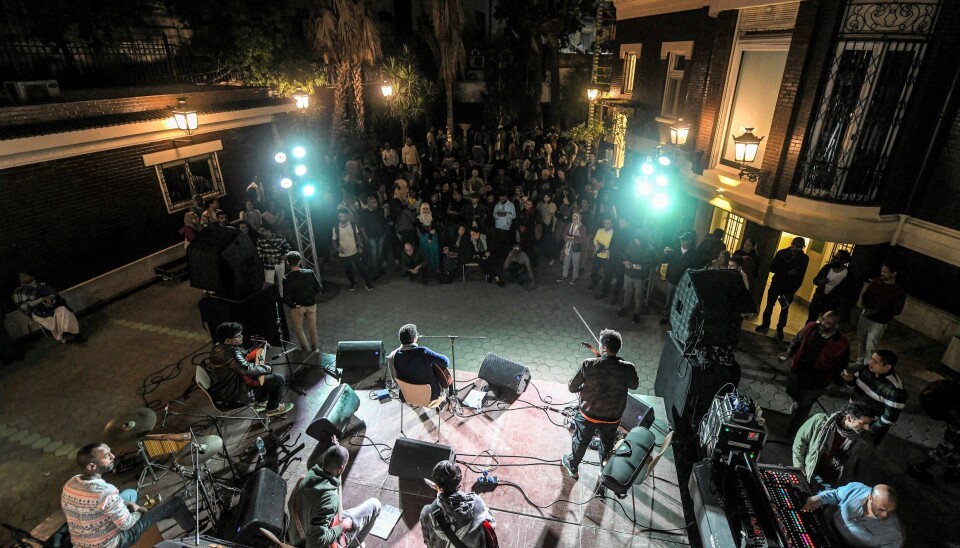
Sudanese singer Mazin Hamid performs during a concert at the Goethe-Institut Cairo.by Ahmed Hasan/AFP via Getty Images
Operating in a dire financial climate, Egyptian art practitioners have long relied on Western funding, which has kept them from maintaining their own ecosystem. “We used to have salons where people played music together, but those spaces are no longer there,” says El Attar. “Those spaces have become the French, German or other foreign institutes, which are now closing their doors bit by bit.”
While some lament the decrease of Western funding and the loss of access to Western-run art spaces, El Attar is amongst those who have found this new reality freeing despite the financial difficulties. “It took me a long time to realize that I don’t want to do things the way they do them,” she says. “Hallelujah!”
The segregation of Egyptian music spaces
“The manager of the conservatoire in Tunis once told me that in Egypt, music was never related to class or intellectualism,” remembers El Attar. “You didn’t need to have money; you could learn it in the street, in village circles and in the mosques. That’s how Egypt became the hub for arts in North Africa and the Middle East.”
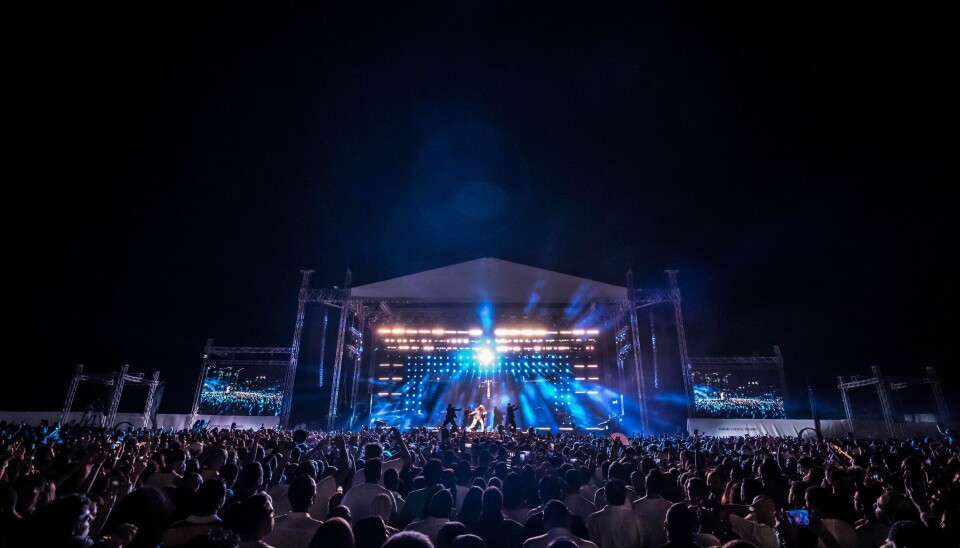
With the quiet disintegration of public space and accessible independent cultural events, most concerts are confined to places that have strong financial and etiquette barriers. Contemporary art forms are heavily segregated. There is Mahraganat, which belongs to the working class, and rap somewhere in the middle (depending on the artist’s financial success), but most other genres and performance art have been moved to rather exclusive and expensive places like concerts at the Pyramids of Giza or at Cairo Jazz Club, which requires a screening of one’s social media and a certain dress code. Increasingly, international artists will not even stop by Cairo and instead perform in gated communities and holiday destinations like El Gouna or the Mediterranean North Coast.
Singer Jennifer Lopez performs onstage during her concert on the beach of the North Coast city of New Alamein.by Khaled Desouki/AFP via Getty Images
As these shared music spaces disappear, Egyptians of different classes struggle to access each other’s lived experiences. An upper-class member will not understand Mahraganat dance, and a working-class member will have never heard of the bilingual, hyper-online Egyptian artists merging “Eastern and Western sounds.”
“The air is getting heavier in Egypt, generally,” says El Attar. Even though Cairo needs more public community events and spaces for music, cultural workers’ capacity to organize them is rapidly shrinking.