Imarhan’s New Album ‘Essam’ Blends Tuareg and Electronic Music
The Tuareg veterans of the desert blues venture into new territory on their fourth studio album, exploring feelings of nostalgia and displacement through electronic soundscapes and synthesized rhythms.
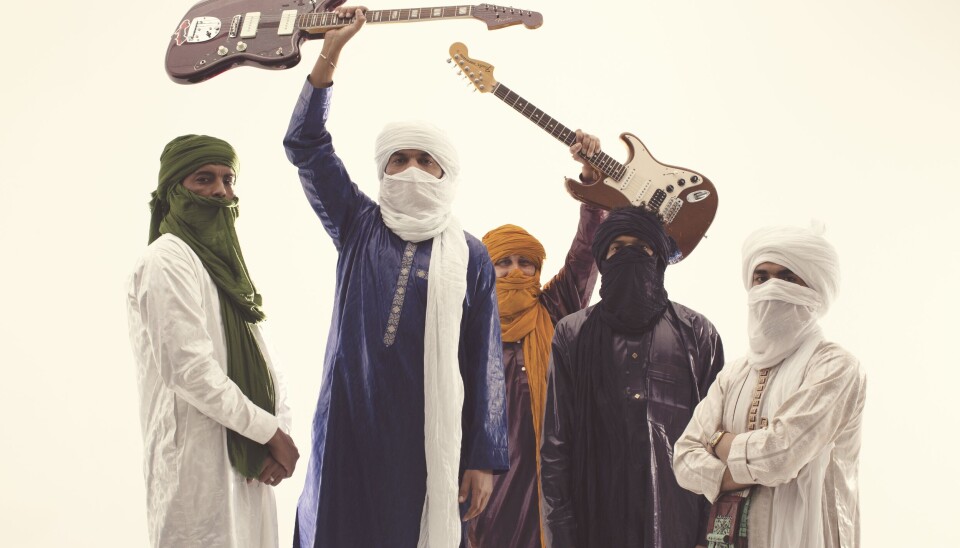
Imarhan are: guitarist and lead vocalist Iyad Moussa Ben Abderahmane aka Sadam, bassist Tahar Khaldi, guitarist Hicham Bouhasse, percussionist Haiballah Akhamouk, and guitarist Abdelkader Ourzig.by Marie Planeille
“How to cope with the epoch we’re in? How to navigate this age? I can’t do it. I can’t take part in this hectic race. I can’t keep up with the times,” sings Iyad Moussa Ben Abderahmane, aka Sadam, lead vocalist of Tuareg band Imarhan, on their new album Essam.
Essam (“lightning” in the Tuareg language of Tamasheq) is the band’s fourth album, recorded at their Aboogi Studio in the heart of Tamanrasset in southern Algeria. The desert blues’ signature guitar chords lead into the first track “Ahitmanin,” but there’s something else interweaving with the voices of their community: a new intimacy, and a foray into electronic production.
“With Essam, we wanted to try something new and mix assouf with other kinds of music,” guitarist Hicham Bouhasse tells OkayAfrica. Assouf, also referred to as “guitar poetry,” is a genre of the Tuareg, a nomadic people that has widely been widely displaced from their land in the Sahara and often reside in refugee camps in Southern Algeria and Northern Mali.
Assouf is Tamasheq and translates to loss, longing, homesickness, or "the pain that is not physical." It is a reflection of displacement, identity, and belonging, some of the album’s core themes. But while nostalgia rings through every song of the album, there’s much more: hope, togetherness, and curiosity.
Since their first self-titled album in 2016, Imarhan collaborated with Gruff Rhys of Super Furry Animals and Giant Sand’s Howe Gelb, opened up for Kurt Vile, and were remixed by Moscoman.by Marie Planeille
On Essam, Imarhan collaborated with French sound engineer Maxime Kosinetz, who produced the album, and French multi-instrumentalist Emile Papandreou. In their Tamanrasset studio, which doubles as a kind of music school and community center, they experimented with electronic synths and notes that could blend with assouf, sampling Imarhan’s live percussion — such as traditional Tuareg instruments like the calabash and jerrycans — and processing them through a modular synthesizer.
This collaboration could only have happened in the desert. “To play assouf, one has to be in the right environment,” says Bouhasse. “Kosinetz and Papandreaou had to come to the desert to feel the atmosphere and play music together without any rush. It happened organically over a lot of time.”
Rather than assouf being changed by the electronic influence, Bouhasse’s description of the album’s process paints a picture of electronic music finding inspiration in the nostalgia of desert blues and molding itself around guitar poetry.
“The process [of making a song] is always different, but usually it starts with something quite personal,” says Bouhasse. “For example, [one of us] will go by himself to the desert and record some ideas on his phone. It could be lyrics or a melody. Then he shows it to the others, and we start working together on the song.”
“Tamiditin,” track four of the album, is a love song written by Sadam. Over looped, pulsing electronic sounds that remind one of a quickly beating heart, and playful guitar chords, a man is thinking about the relationship with his far-away wife. It’s a visceral song that will put a smile on your face, whether you understand its lyrics or not. There’s a lightness in the guitar chords that opens up the chest. There’s a sincerity and softness in Sadam’s voice that makes the world stand still for six precious minutes as he sings “My dearest, I’m so far away from you. I’m just getting your news. /At nightfall, my longing for you takes hold of me. /When dusk appears, you haunt my thoughts.”
A Recipe for Assouf: Blending Tradition and Modernity
While they have built a lively community hub, the members of Imarhan are also noticing that younger generations are at risk of losing their traditions.by Marie Planeille
How does Imarhan find the balance between experimenting with various genres and honoring assouf? “[After 20 years of playing together] we know our style very well. It’s like cooking, and we know how much salt to put into our music without it getting too salty,” says Bouhasse.
“We really tried to do something important, something that makes sense,” he continues. “I hope that this album can give courage to Tuareg bands, because it shows that it's possible to mix our music with other styles. A lot of Tuareg bands are scared to move away from the traditional styles, but it's okay to bring in new elements. [Essam is meant to] show the possibilities that you can have with Tuareg music today.”
Fittingly, Essam closes with “Assagasswar,” a song based on an old poem. Over simple guitar chords and the traditional tinde drum, Sadam and a choir sing the story of the mountains, which protect the city of Tamanrasset, talking to each other.
To the band, this album felt like a risk and a departure from their previous creations. While it experiments and ventures out, it always finds its way back to the source of its inspiration, taking listeners on a non-linear journey of stillness, movement, nostalgia, and joy.