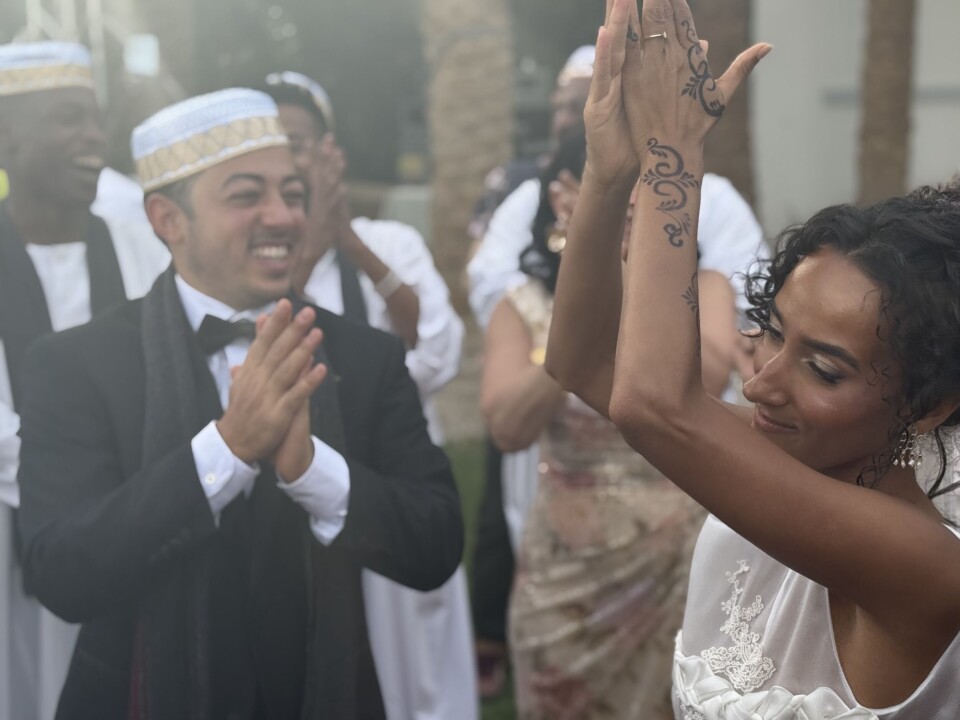
Learn About My People Through Joy: A Sudanese Egyptian Wedding
After years of reporting and writing about the war, I figured out the best way to get people interested in Sudan: hire musicians and throw a huge wedding party.
Amuna WagnerAmunaWagnerCairo-Based North Africa Correspondent
At OkayAfrica, music is our lens to understanding the world; we listen for the wisdom it conveys and the societal (r)evolutions it carries. Sudan, with its millennia-old sounds, genres, and instruments, offers an endless listening experience.by Mo Saeed/Design by Kaushik Kalindidi for OkayAfrica.
When Khartoum was engulfed by war on April 15, 2023, I was on the beach in Vietnam. An Al Jazeera news flash popped up on my Instagram feed, and a few days later, some of my family members were in the desert fleeing to Egypt, while others had disappeared.
Outside of my phone, life continued as normal. After the initial shock, I realized that nothing had changed for most people in the world. My closest friends checked in with me, but hardly anyone made the time to watch the informative videos I shared online. Speaking about the war felt like speaking into a void.
In 2024, I became OkayAfrica’s North Africa correspondent and have since covered the situation in Sudan from every angle, reaching more people than I could have ever hoped. It felt like I was doing something to help, and that mattered more than anything else. What else could matter when your people are going through the world’s worst humanitarian crisis?
On a trip to Spain in October that year, my partner dropped a silver spoon into my cappuccino. Its engraving read: “Will You Marry Me?”
Surely we could not have fun and waste an enormous amount of money while people were starving to death. Or could we? As I shared the news with my community, they cried and laughed with joy. A wedding would not be a tone-deaf indulgence, they said. It’s exactly what we need: something to look forward to.
According to my mother, I have been dreaming of my wedding since I was three years old, so I did not need much convincing. The guilt remained, but I started planning and learning about the ancient traditions of Sudanese wedding ceremonies and the music that accompanies them. At OkayAfrica, music is our lens to understanding the world; we listen for the wisdom it conveys and the societal (r)evolutions it carries. Sudan, with its millennia-old sounds, genres, and instruments, offers an endless listening experience.
As I hired musicians, made playlists, and practiced traditional dances, the philosophy that drives my work was proven right in front of my eyes: music can create an understanding between people(s) that most other languages cannot.
One week of relentless celebration stirred more interest among our guests and, thanks to social media, their communities than any of my previous writing and activism has. After two years of trying to get people invested in Sudan, it was the music that eventually drew them in.
So let me show you what we played.
Aghani El Banat
Sudan has an ancient tradition of adorning newlyweds with henna. The bride’s family and friends gather at her house, burn incense, and exchange marriage advice while an artist draws black geometric patterns on their feet, legs, hands, and arms.
The henna party was my last chance to perfect the Ragees Al Aroos (bridal dance), which I did not grow up learning, but somehow was expected to perform at one of the events. In the midst of the women of the community (or in earlier times, the entire village), the bride displays her beauty and wealth while choreographing the newlyweds’ journey from courtship onwards. The groom stands in front of her and has to catch her whenever she unexpectedly drops to the floor.
“When your back feels like it’s about to break, you’re in the right spot,” one cousin told me and my friends, who could not sit still listening to Aghani El Banat(Girls’ Songs). The musical foundation of a Sudanese wedding, it is the only genre that is fully created and performed by women. Passed down orally, the call-and-response songs are traditionally sung by the ghanaya, a woman who plays the dalooka, a goblet-shaped drum made of clay and stretched animal skin, originating in the Darfur region. They praise the prophet and address themes of love and relationships, playing with explicit flirtation and subtle sexual innuendos — innuendos that I, the bride, was supposed to translate into sexy dance moves.
“How many dances will you do, ten?” asked one of the aunties when we were done with all the henna adornments and sweating from dance practice. “Less than one,” I answered, to her dismay.
Zanig
The henna and dance sessions were in preparation for the Jirtig, an ancient Nubian rite of passage. The bride wears a red garment that symbolizes a blood sacrifice, and she is drenched in gold and incense, which connect her with the divine. The groom wears all white and carries a sword (which is illegal in Cairo, so my groom carried a stick instead).
In typical Cairo fashion, we got stuck in traffic and arrived hours after the Jirtig had started. I worried about the foreigners who had arrived on time until my British Jamaican friend texted “THE MUSIC IS AMAZING,” and my Nicaraguan Canadian friend sent a video of a raging party.
We stepped into the venue to a gona (woman singer) chanting our names. Traditionally, the bride is supposed to look demure upon entering the celebration, but I could not resist the high-energy beats. I came in bopping and smiling, seeing the sweat glistening on everyone’s exhilarated faces.
A percussionist playing a daf (frame drum) escorted us in, playing alongside a keyboardist who was improvising over looped beat samples. The gona kept chanting my father and aunt’s names, praising our family and shouting out the different Cairene neighborhoods people had arrived from.
This music is called Zanig, a genre that originated in the streets of Khartoum in the early 2000s. Known for its innovative melodies and rich percussion that draws on African dance music, specifically Congolese influences, it quickly became the sound of marginalized Sudanese youth under the dictatorship of Omar al-Bashir.
With every new song, phones were held up in the air to Shazam the tunes. “Her voice is so strong, what is she saying?” people asked in awe of the singer’s loud confidence. “A gona is usually dissing someone, it’s somehow the equivalent of rap in our culture,” explained one Sudanese friend.
Because they challenge societal norms through their artistic expression, both Zanig and Aghani El Banat have been stigmatized in Sudanese society for being working-class genres. Zanig was initially ostracized because of a generational gap, classism, and its taboo-breaking lyrics, but it has established itself as one of Sudan’s leading genres, growing from a sound to a culture that has spilled over into the mainstream. Playing it at an ancient ritual was a testament to the ways we can honor our traditions while pushing the boundaries of inclusion, acceptance, and societal evolution.
The Nubian Zaffa
We began our final wedding event by the Red Sea with the Nubian Zaffa (wedding procession), another ancient ritual. Commonly practiced throughout the Arab World, every culture adds its own touch to welcoming the newlyweds to the party.
A troupe of Nubian dancers welcomed us on the beach, forming two lines to our sides and chiming in a chorus with the lead singer. To the pulsating rhythms of the daf and the tabla, they performed traditional and popular Nubian and Sudanese songs like Mohamed Mounir’s “Fi 3sh2 El Banat” and Shoukrallah Ezz Eldin’s “Allalah Belil,” reminding our families of how much the two countries have in common.
As we approached our guests, the troupe formed circles around us and danced in elaborate choreographies, repeatedly hyping the crowd and singling out specific aunties to dance with. They placed their hands on the groom, blessing him at the beginning of this new chapter and encouraging him to walk with confidence.
Between piercing zagharit (ululations) and beats that became faster and more intense with every song, we began our wedding with ecstatic dance, jumping around our guests before we had even welcomed them. The music quite literally merged our worlds and ushered us into a new life together, creating an emotional bond with our community and inviting them to be a part of our relationship.
Head over to OkayAfrica’s YouTube channel to see videos of the Zaffa.by Ghita Benslimane.
In the past three years, a certain bitterness has befallen many elders in my family. After decades of coups and dictatorship, many are not as enthusiastic about better days as we, the younger people are. “Leave Sudan alone,” my father, aunts, and uncles often tell me.
They had stopped listening to our music because it made them cry. They stopped talking about Sudan to non-Sudanese because they could not bear the indifference to their people’s suffering. But after they saw the admiration in everyone’s eyes at their shoulder dance and the excitement about every new song, they felt proud again.
My aunts extended an invitation to our wedding guests and hosted a traditional coffee ceremony and delicious dinner at their home in Cairo. People came with questions — how did you spice this sauce, when did you first learn this dance, how come you’re all great singers — and reflected on their previous lack of interest. And while I’ll probably still go back to that dark place of “nothing I can do will help” every now and then, my family and I learned an important lesson: we can trust our culture to do the work and our music to speak for us.