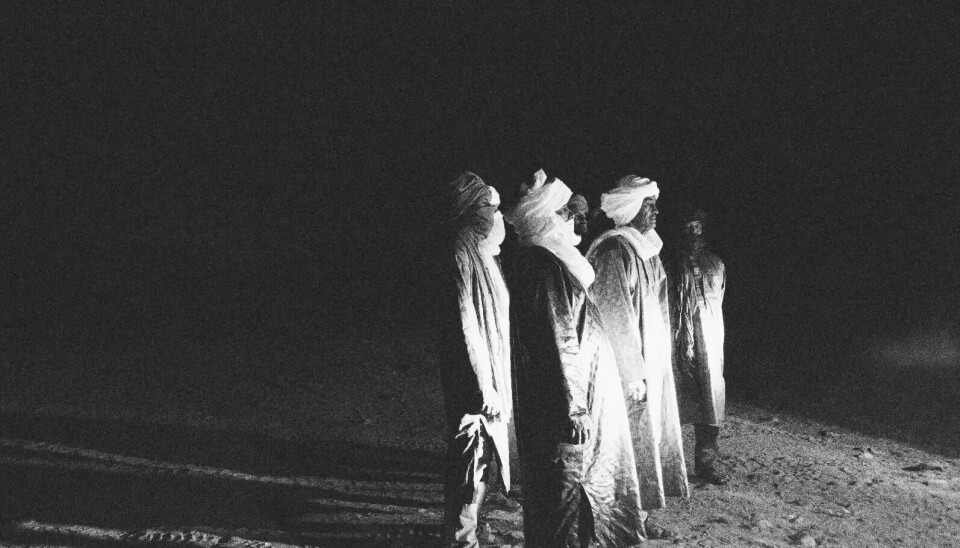
Tinariwen’s New Album ‘Hoggar’ Reunites the Tuareg Community to Preserve Its Resistance
The Grammy-Award-winning band’s tenth studio album sees them return to basics in collaboration with several younger musicians, as politically outspoken and thoughtful as ever.
Amuna WagnerAmunaWagnerCairo-Based North Africa Correspondent
From wisdom about love and life to angry criticism of division and Wagner group mercenaries, Hoggar continues to reflect the complexity of modern Tuareg life.by Marie Planeille
When I call Abdallah Ag Alhousseyni to discuss Tinariwen’s new album Hoggar, he is getting ready to leave the house. While he wraps a turban around his head, a little boy picks up the camera, introduces himself, and, repeating after Alhousseyni, says, “I am a child of the desert.”
The boy entertains me for a while, then Alhousseyni takes the phone back, walks through a spacious room, into a yard, and then to a car. He places the phone behind the steering wheel and starts to drive.
“Hoggar was a beautiful experience for me. It’s the first time we recorded an album in Tamanrasset,” he says. A cultural, economic, and administrative hub, the oasis city in southern Algeria is often referred to as Algeria’s Tuareg capital. Tinariwen’s founding members, as well as the second and third generations of musicians who later joined the band, first started playing music there in 1979.
Tamanrasset is an important place for Tuareg music, and a crossroad for those who want to see family and friends when travelling to Libya or Azawad. It’s a good place to find and inspire all kinds of Tuareg musicians for a collaborative project like Hoggar.by Marie Planeille
Hoggar was recorded at Aboogie, the studio of Iyad Moussa Ben Abderahmane, commonly known as Sadam. He is the lead singer of the Tuareg band Imarhan and a cousin of Tinariwen’s Eyadou Ag Leche, and he made it possible for Tinariwen to record at home with professional gear for the first time.
This tenth studio album is a musical and visual journey through eleven tracks, including some old Tinariwen songs that have never been recorded before. Their message of resistance still rings as true today as it did several decades ago, blending their signature desert blues assouf with local rhythms, Sudanese music, and the call-and-response vocals of their community members.
The little boy’s head pops into the screen from the car’s backseat, eyeing the phone with curiosity. Alhousseyni continues to look ahead, but his lips betray an amused smile.
“We had the opportunity to invite a Sudanese singer, Sulafa Elyas, and that’s probably my favorite song on the album,” he says. “It’s important for us to emphasize the link and similarities between Tuareg and Sudanese music.” I tell him that I am Sudanese, and he laughs in pleasant surprise. “I’m a big fan of Sudanese music, I’ve always wanted to make music with an artist from there,” he says. “My biggest influences are from Sudan, Mauritania, and country music.”
“Would you like to see the mountains in Tamanrasset?” he asks, flipping the camera. “Look, look! This one is called Adrian.” He is driving through an arid landscape shortly before sunset, with the mountains on the horizon glowing in the day’s last sunrays. The album’s title, Hoggar, is named after these very same mountains, a unifying place and ancestral home.
However, tracks like “Imidiwan Takyadam” and “Erghad Afewo” address the difficulty of being refugees scattered across the land and the disunity that has plagued the Tuareg community. “In the north of Mali, there are those who fight for the Azawad state, and those who are with the Malian army, and even other groups, and they all disagree with each other,” explains Alhousseyni.
The process of recording Hoggar centered on bringing the community together, as heard in the choir.
“As an artist, you write songs and poetry when you’re young, and when you get older, it’s hard to recreate that special energy,” says Alhousseyni about inviting younger generations to collaborate on the album. “In our culture, we pass the torch early, rather than waiting until the last minute. We have a lot to tell young musicians about nature, animals, education, suffering, colonization, and life in the desert.”
Tinariwen wants to ensure that future generations feel involved in and invested in Tuareg heritage. There will be some revolutionaries among them, and Alhousseyni hopes they will choose to resist and defend the Tuaregs' cause in the way they see fit. That does not mean that all their music has to be as political as Tinariwen’s; it should simply reflect Tuareg life as it progresses.
The Continuum of Tuareg Music
“It’s a great honor to have hosted the sessions for Hoggar.” - Iyad “Sadam” Moussa Ben Abderahmaneby Marie Planeille
Sadam is one of the youngest musicians to feature on Hoggar, playing the guitar and singing on several songs. “Tinariwen opened a lot of doors for younger musicians like myself. Being a part of recording Hoggar with a new lineup and energy was very inspiring,” he tells OkayAfrica. “They returned to the basics, and it brought back a lot of memories from my childhood.”
He cherishes the moments when Tinariwen, members of the Tuareg band Terakraft, and local women singers would drink tea and play dominoes like one big family. “It felt like being in a movie, or a dream come true,” he says. “The whole scene was reunited in one place, making history in a simple, modest way.”
Sadam does not feel like the torch has been passed to his generation with Hoggar. To him, this album is a continuum of the tradition: Tuareg music has always been made in community, with everyone playing a role according to their age. “The old inspire the young, and the young bring new energy to go further,” he says.
Going further does not necessarily mean that younger generations will become even more political; sometimes it means the exact opposite. “History repeats itself,” says Sadam. “The love stories in our songs stay the same, and the political issues Tuaregs face tend to repeat themselves, too.”
Since the problems addressed in Tinariwen’s music remain unresolved, younger generations may not have much political input to offer. Sadam believes that, rather than echoing Tinariwen, they can take the music itself further.
“Tinariwen has said everything already, but sometimes we can raise issues differently in our poetry about daily life,” he says. “Sometimes we can take a more optimistic view and talk about good things like love and relationships and how our communication has changed.”
Still, one of Sadam’s favorite songs on the album, “Aba Malik,” criticizes the crimes that the Russian mercenary group Wagner is committing in Azawad. Featuring a song that so urgently meets the contemporary moment alongside timeless tracks about the kindness we must share for one another is a testament to Tinariwen’s unique ability to grasp the complexity of Tuareg life, both sonically and thematically.
One of the traditions Tinariwen are eager to uphold is to honor women as the historical custodians of Tuareg music. “In 1973, there was a big drought, and a lot of Tuaregs moved to cities in Mauritania and Niger where their lifestyles changed,” says Alhousseyni. “In cities, it was not as easy for women to play music, because they used to have more freedom in camps.”
Hoggar’s visuals not only tell the story of a young man struggling against the state and finding music as a way of resistance, but also of a woman who is undergoing her own journey alongside him.
“I’m happy that there’s a new dynamic with young women taking part in recording music,” says Sadam. One of these women is Wonou Walet Sidati, who previously sang with Tinariwen on their fourth studio album Imidiwan.
“I love music, because it gives us the opportunity to tell our story, talk about how we live and what’s happening out here in the bush,” she tells OkayAfrica. “Tinariwen are like my brothers, so it was great to reconnect and play music together again. There were a lot of people stopping by [the studio,] young and old. I liked that energy, it’s good for me.”
The sun is about to set. “It’s not easy to have this much time available during Ramadan,” says Alhousseyn, hinting at how long our conversation has gone on. He chuckles, and we say our goodbyes, but not before he sings to me his favorite Sudanese song, “Ard Alhabib” (Land of the Beloved).